

Praia do Seixal #1
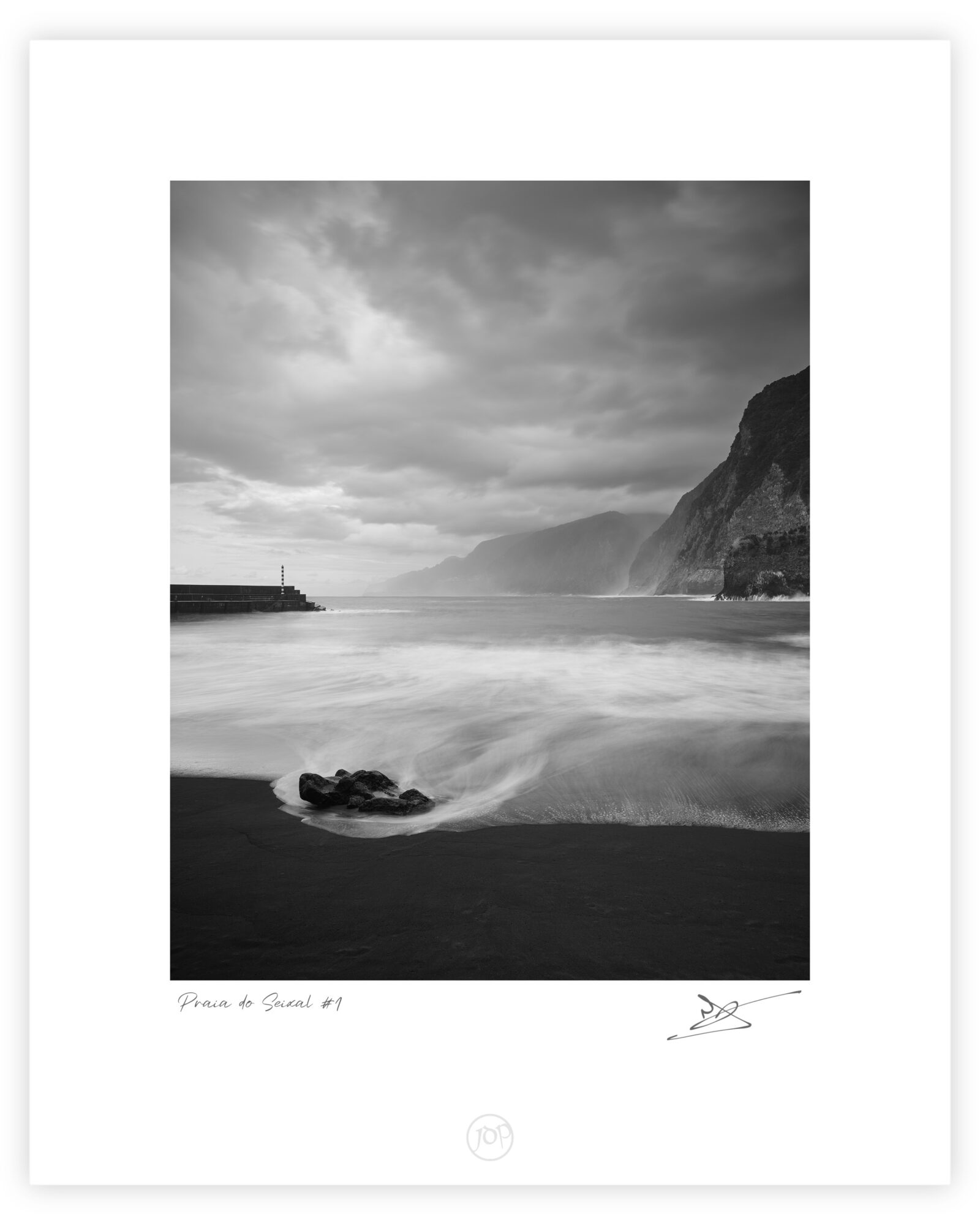

Praia do Seixal was one of the places that kept drawing me back during my first visit to Madeira in 2023. I returned three times over ten days, taken by the black sand, the compact harbour and the cliffs folding one behind another along the coast. This photograph came from the last of those visits, when rolling cloud and a rough sea gave the beach a character quite unlike the quieter conditions I had encountered before.
Returning to the Same Shore
The harbour wall and the distant cliffs were central to what interested me about this viewpoint. Both are solid forms, but they belong to very different parts of the landscape. The wall enters from the left as a low, ordered structure, marked by its narrow striped beacon. On the opposite side, the cliffs rise irregularly from the sea and gradually lose definition through distance and spray.
Between them, the water remains open and unsettled. The foreground rock gave that movement something to gather around and, just as importantly, something from which it could retreat. Once I had settled on that relationship, the question became how much of the sea’s movement the exposure should retain.
Measuring the Retreat
When working with waves, I often begin by watching how long it takes the water to leave the principal element in the composition. I count those seconds in my head and use that as a baseline, then make a series of photographs above and below it until the movement feels right.
Here, eight seconds provided the balance I wanted. It was long enough to draw out the backwash as it moved around the foreground rock, but short enough to keep texture and density within the sea. The water has shape rather than becoming an empty, featureless surface.
The resulting lines carry the eye away from the foreground and towards the open water. Above them, the broad movement within the clouds appears to follow the same outward direction. That connection between sea and sky became one of the photograph’s strongest qualities, while the harbour wall and cliffs give the frame the weight needed to contain it.
Why Black and White
Black and white distilled the scene to the elements that mattered most: the dark sand, the pale movement of the water, the mass of the cliffs and the changing luminosity of the sky. Removing colour also brought the visual relationship between the sea and cloud closer together. They no longer read as separate parts of the landscape, but as two forms of movement passing through the frame.
The photograph is markedly different from Sunrise at Praia do Seixal #1, made at the same location with an eight-minute exposure and a restrained, minimal palette. That longer exposure produced a much quieter interpretation of the shore. This image retains more of the sea’s physical force and the instability of the weather, showing how differently the same place can present itself on different days.
What remains for me is that balance between movement and permanence. The water and cloud appear to be pulling away, while the rock, harbour wall and cliffs hold their positions. It reflects Praia do Seixal as I experienced it on that last return: changeable, dramatic and still full of structure beneath the movement.
You can find more images from Portugal in my Europe & Beyond portfolio or in my Seascapes & Shorelines portfolio.
Praia do Seixal #1 is now available as a signed Fine Art Giclée print. On archival paper, its deep volcanic blacks and layered silvery greys gain a physical depth that holds the movement of sea and cloud within the finished work.
HOW I SHOT IT
CAMERA: Fujifilm GFX100S
LENS: Fujinon GF20-35mm F4 R WR
EXPOSURE: 8″
APERTURE: f/13
FOCAL LENGTH: 35mm
ISO: 100