

Sunrise over Dunas de Maspalomas #1
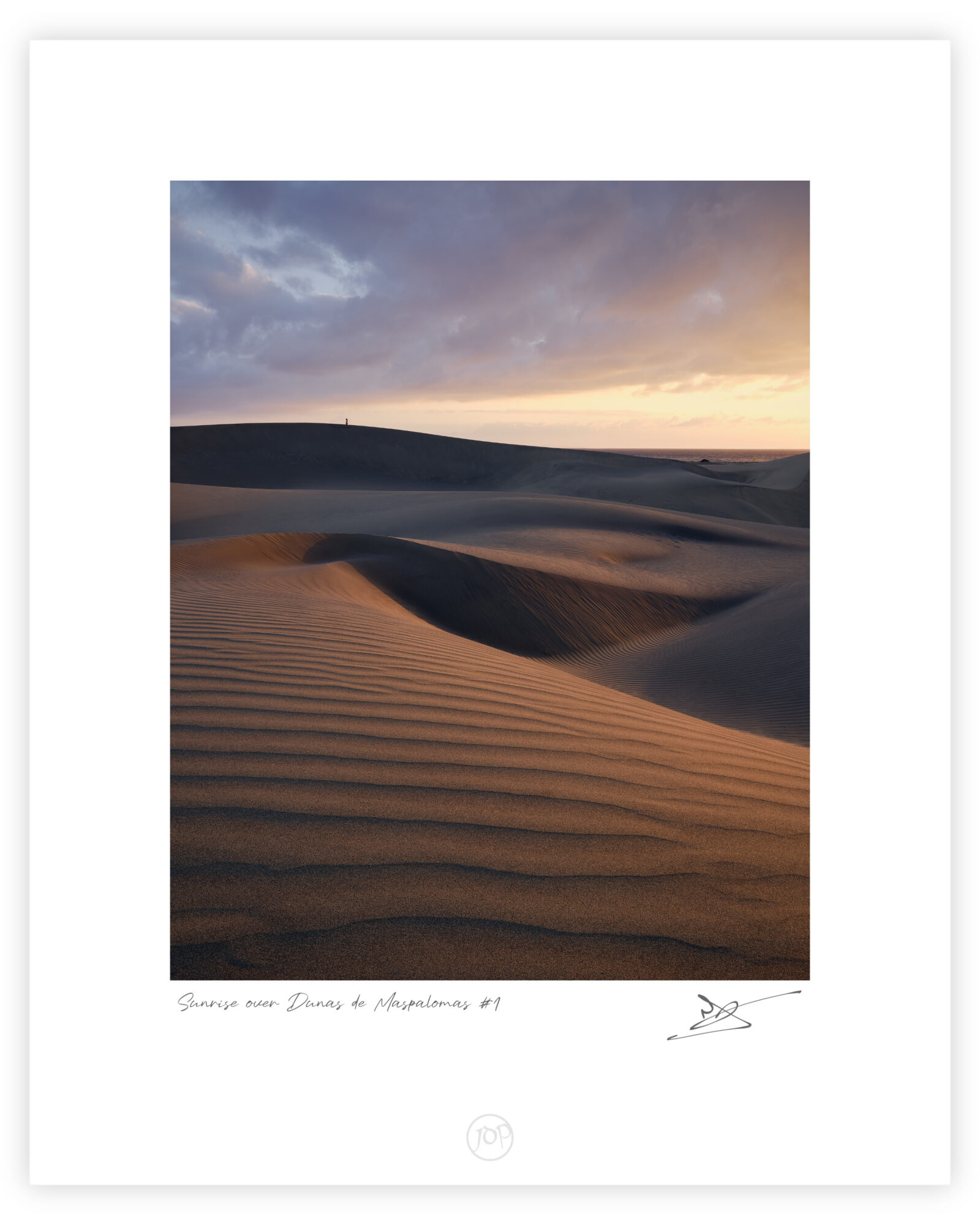

The Dunas de Maspalomas were the main photographic reason I wanted to visit Gran Canaria. I had wanted to spend proper time photographing dunes for years, not simply pass through them for an afternoon, and this January trip finally gave me the opportunity. The dunes form part of the protected Reserva Natural Especial de las Dunas de Maspalomas in the south of Gran Canaria, but for me the attraction was much simpler: light, sand, changing form and the possibility of working with a landscape quite unlike those I know at home.
This was my first time on the island, and the trip was also something of an escape. Ireland had been going through what felt like an endless stretch of rain, grey skies and short winter days. Six days of blue skies, temperatures around 21 degrees and several additional hours of daylight did more for me than I expected. Photography was the reason for going, but the change of light and rhythm mattered just as much.
Returning to the Dunes
I visited the dunes for four sunrises during those six days. This photograph came from the third.
One of the things I quickly learned was that sunrise suited the way I wanted to work there far better than sunset. It was quieter, for one thing, but the difference in the sand was just as important. By evening there were footprints almost everywhere. Overnight, the wind had time to soften or remove much of that disturbance, and by morning the dunes could feel newly made.
That became part of the fascination. I was returning to the same place, but never quite returning to the same landscape.
The wind continually altered the surface. Ridges shifted, ripples developed, edges softened and new curves appeared. Even across four mornings there was no sense of simply repeating a composition. Each visit involved looking again and responding to what was actually there.
The Third Sunrise
On this morning the first thing that held me was the way the low light travelled across the sand. The foreground was full of fine parallel ripples, but beyond them the dunes broadened into much larger, slower curves. Warm light caught the raised surfaces while the hollows remained cool and dark, allowing those forms to separate almost graphically.
Above them sat a large weight of blue-grey cloud. Near the horizon it opened just enough for the rising sun to come through, warming both the sand and the underside of the cloud. That narrow transition between the coolness of the remaining night and the first warmth of day became as important to the picture as the dunes themselves.
The Figure on the Ridge
A lone person stood on the crest of the furthest dune, presumably there for much the same reason I was, to watch another day begin. At that distance the person is almost insignificant, just a small vertical mark against a long horizontal ridge. But without them the scale of the dunes is much harder to judge.
I did not need the figure to become the subject. Their presence simply gave the landscape a measure.
This is the first photograph I have published from Gran Canaria, and perhaps appropriately it comes from the place that drew me there in the first place. If anything, those four mornings left me more interested in dunes than I had been before the trip. They combine qualities I am repeatedly drawn to elsewhere in the landscape: form, tone, changing light and the need to work with what is present rather than impose something upon it.
What remains for me in the finished photograph is that brief balance between permanence and change. The dunes look settled, almost sculptural, but none of those lines are fixed. The light would move, the wind would rise and the surface would be rewritten again.
You can find more images from Gran Canaria in my Europe & Beyond portfolio or in my Seascapes & Shorelines portfolio.
Sunrise over Dunas de Maspalomas #1 is now available as a signed Fine Art Giclée print. The warm sand, cool shadow and fine foreground ripples gain added separation and presence on archival paper.
HOW I SHOT IT
CAMERA: Fujifilm GFX100 II
LENS: Fujinon GF35-70mm F4.5-5.6 WR
EXPOSURE: 1/10″
APERTURE: f/14
FOCAL LENGTH: 35mm
ISO: 80